
Solar Shingle Brands in Wisconsin: Solstice, Landmark PWR, GAF & Kaneka Compared (2026)

Updated: 2 days ago
Which Solar Shingle Brands Can You Buy in Wisconsin in 2026?
Updated October 2026.
Of the solar shingle brands, only CertainTeed's is installed in Wisconsin in 2026: Solstice is available now through CertainTeed-credentialed roofing contractors, including Sun Vault Roofing. CertainTeed's newer Landmark PWR is reported to become officially available November 1, 2026. Tesla has reportedly stopped selling its Solar Roof, GAF has told us it is not currently offering its solar shingle in Wisconsin, and Kaneka's is not available for U.S. residential installs.
"Solar shingle" is a category, not one product, and the products inside it differ in materials, wiring, and who can install and service them. In Wisconsin, with heavy snow, freeze-thaw cycles and hail, those differences matter more than the headline watts. For the Tesla story and what it means for homeowners, see Tesla Solar Roof discontinued: what it means for solar shingles in Wisconsin.
Key Takeaways: Solar Shingle Brands Available in Wisconsin in 2026
Availability decides this comparison. As of October 2026, CertainTeed's Solstice is the solar shingle installed here, with Landmark PWR reported to follow November 1. Tesla reportedly stopped supplying Solar Roof tiles in August 2026, GAF has told us it is not offering its solar shingle in Wisconsin, and Kaneka's is not available for U.S. residential installs.
Solstice works with CertainTeed's asphalt shingles around the array. A roofing crew installs the shingles and a licensed electrician makes the electrical connections, the same electrician role a rack system needs.
Landmark PWR is a bigger shingle, not a denser one. It is rated 85 watts versus 70, but power per square foot of shingle is about the same, roughly 16 watts.
Wisconsin weather matters as much as watts. Ask how a product was hail-tested and what the plan is for snow sliding off the array.
What Is the Difference Between Asphalt Shingles and Solar Shingles?
A standard asphalt shingle has one job: shed water and protect the roof deck. A solar shingle does that same job and also generates electricity, with photovoltaic cells (the parts that turn sunlight into power) built into the shingle instead of mounted above it on a rack.
Asphalt shingles cost less, install faster, and almost any crew can repair them. Solar shingles cost more upfront and are installed by a roofing crew trained on the product, with an electrician making the connections. In return, they remove the look of rack-mounted panels and turn the roof surface into a power source. Most solar shingle roofs, including Solstice, still use ordinary asphalt shingles on the parts of the roof without solar, so the two products share one roof.
The best time to choose a solar shingle roof is when you are building new or replacing the roof anyway, because the solar layer goes in as part of the roof. CertainTeed's guide says the product is for new construction or re-roofing, not for going over an existing roof.
Which Solar Shingle Brands Are Available in Wisconsin? Quick Comparison
Product | Power per shingle | Hail rating (test used) | Available in Wisconsin (October 2026) |
CertainTeed Solstice | 70 W | Class 3 (ice-ball test, FM 4473) | Yes. Installed by CertainTeed-credentialed contractors, including Sun Vault Roofing |
CertainTeed Landmark PWR | 85 W | Class 3 (ice-ball test, FM 4473) | Officially available November 1, 2026, per Solar Power World. Sun Vault Roofing plans to begin installing it in spring 2027 if it is shipping by then |
GAF Timberline Solar ES 2 | 57 W (GAF's published rating) | Class 4 (steel-ball test, UL 2218), for qualifying packages only | GAF has told us it is not currently offering it in Wisconsin |
Tesla Solar Roof | 72 W per tile (Tesla's published rating) | Class 4 (steel-ball test, UL 2218), per Tesla | Discontinued (reported August 2026) |
Kaneka | Not published for the U.S. market | Not established for the U.S. market | Not available for U.S. residential installs |
FM 4473 and UL 2218 are different hail tests, so the classes are a guide, not a like-for-like ladder. GAF's figures come from GAF's product page and Tesla's from its construction specification.
How Do the Major Solar Shingle Brands Compare?
CertainTeed Solstice

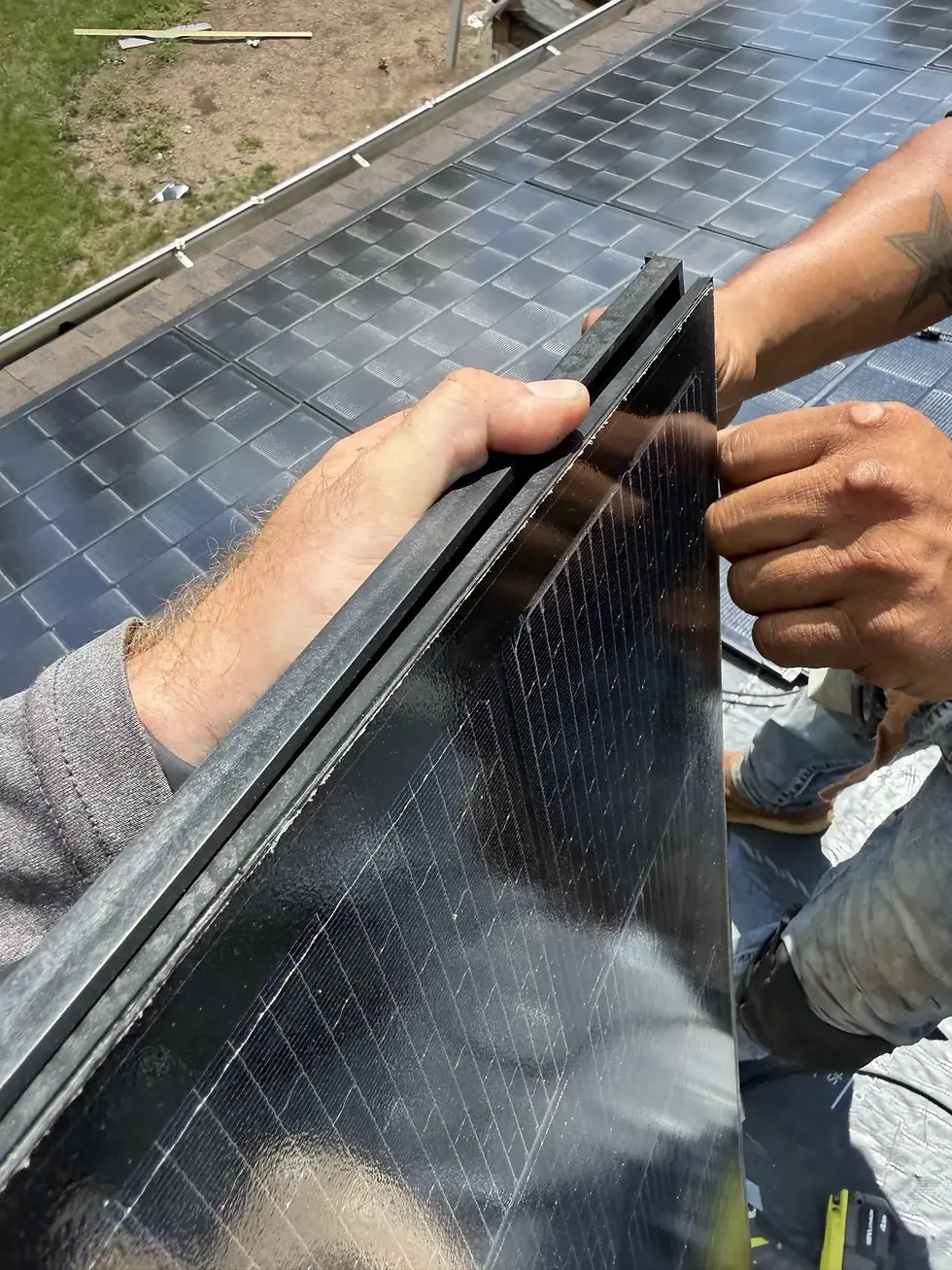
CertainTeed's Solstice is built to look and install like an asphalt shingle. The solar shingles sit in the same field as the asphalt shingles around them, and CertainTeed says any of its asphalt shingle lines can be used around a Solstice array.

It goes on the roof deck with standard deck screws, with clips connecting adjoining courses, so a roofing crew already knows the installation logic. CertainTeed's datasheet lists the 110 mph wind test class and a Florida Building Code hurricane-zone product approval. For hail it holds a Class 3 rating under FM 4473, an ice-ball test, on a scale where 4 is highest. No rating guarantees a roof against a direct hit.
CertainTeed backs it with a 25-year limited power warranty and a 25-year limited workmanship warranty. Solstice won a Best of IBS Award for Best Energy Efficient Product at the 2024 International Builders' Show.
CertainTeed Landmark PWR
CertainTeed's solar shingle line began with Apollo II, a first-generation product that is no longer installed. Solstice followed, and Landmark PWR is the newest generation. CertainTeed announced it in late September 2026, and Solar Power World reports it becomes officially available November 1, 2026.

What changes from Solstice:
More power per shingle. 85 watts versus 70. It is also a bigger shingle, so power per square foot of shingle is about the same, roughly 16 watts by our math from the datasheets.
Individual shingles can be replaced. We have seen video of a Landmark PWR shingle being popped out and replaced on its own. It is like replacing a panel but easier: the shingles are smaller, there is no racking to unfasten, and you can walk on the shingles around it.
Works with module-level electronics. Landmark PWR now works with module-level electronics, small devices that manage each shingle individually.
A wind warranty. A 10-year, 110 mph limited wind warranty, alongside 25-year limited power and workmanship warranties.
A frameless look. There is no visible frame around each shingle.
Landmark PWR is rated for roofs with a pitch of 4/12 or steeper (4 inches of rise per 12 inches of run). Solstice's literature allows 2/12, but we would never put it on a 2/12 roof and CertainTeed has told us they prefer to keep it at 4/12 or above, which is why Landmark PWR carries that minimum. In practice that is not a difference. Landmark PWR is heavier per square foot, about 4 pounds versus 2.3 by our math from the datasheets.
We have not installed one yet. We have weekly calls with CertainTeed, have discussed Landmark PWR with them at length for months, and have seen it installed on video, so our labor numbers are projections, but informed ones. We plan to begin installing Landmark PWR in spring 2027 if it is shipping by then.
CertainTeed's marketing calls it cost-comparable to a new roof with rack-mounted panels. We do not expect it to reach parity with rack-mounted panels, but we do expect it to be closer than Solstice, and a bit cheaper. Once it is available we expect to install Landmark PWR instead of Solstice unless Solstice pricing drops.
We will update this page once we have installed and priced one.
Tesla Solar Roof
Tesla's Solar Roof used glass tiles, some of them active.

Tesla reportedly stopped selling it in August 2026. Its web page now redirects to its solar panels page, and we found no formal announcement from Tesla. Electrek reported on August 20, 2026 that Tesla told its certified installers the tiles can no longer be ordered, and that one source said Tesla concluded the product was not financially viable.
Electrek's September 1 follow-up reports that Tesla says it will honor existing warranties and continue to provide replacement parts, while installers doubt that holds for the 25-year life of the roofs. If you own one, ask Tesla Energy in writing how long replacement parts will be available.
Sun Vault Roofing has no first-hand experience installing Tesla's Solar Roof. For what the exit means for Wisconsin homeowners, read our Tesla Solar Roof discontinued article.
GAF Timberline Solar
GAF's Timberline Solar ES 2 is GAF Energy's solar shingle. It is a nailable shingle that pairs with GAF's own Timberline asphalt shingle line and is installed by GAF-certified contractors.

GAF has told us it is not currently offering its solar shingle in Wisconsin. Sun Vault Roofing has no first-hand experience installing GAF's product, and what we know of it comes from GAF and other industry sources. On impact, GAF's qualifying packages are rated Class 4 under UL 2218, a steel-ball test, while Solstice is rated Class 3 under FM 4473. Those are different tests, so treat the numbers as a guide, not a one-class gap. With GAF, coverage for the inverter and electronics is a paid add-on.
Kaneka
Kaneka is a Japanese manufacturer of roof-integrated photovoltaic tiles. Its product is not available for U.S. residential installs, so it is not a practical option for a Wisconsin roof today. It is a name worth knowing as the market develops.

How Are Solar Shingles Made and Installed?
CertainTeed's Solstice is a glass-topped shingle in a resin frame that a roofing crew installs with deck screws and clips. Landmark PWR is frameless in appearance.
Feature | CertainTeed Solstice | CertainTeed Landmark PWR |
Surface | Glass top in a durable resin frame | Glass and laminate, frameless appearance |
Roof around the array | CertainTeed asphalt shingles | CertainTeed asphalt shingles |
Mounting | Deck screws into the sheathing, wind clips between courses | Not stated on the datasheet we reviewed |
Minimum roof pitch | 4/12 or steeper in practice (the literature allows 2/12) | 4/12 |
Weight per square foot | 2.3 lb | About 4 lb (our math from the datasheet) |
Hail rating | Class 3 (ice-ball test, FM 4473) | Class 3 (ice-ball test, FM 4473) |
Wind rating | Tested to 110 mph | Tested to 110 mph, with a 10-year limited wind warranty |
Battery storage | Can be added; compatibility depends on the inverter your electrician specifies | Same |
How Much Power Does a Solar Shingle Make per Square Foot?
Product | Rated power | Exposed area | Power per square foot |
Solstice shingle | 70 W | 4.35 sq ft | About 16.1 W |
Landmark PWR shingle | 85 W | 5.35 sq ft | About 15.9 W |
Full-size residential panel | 400-430 W | About 20.8 sq ft | About 19 to 21 W |
The new shingle is bigger, not denser. Per square foot of shingle, solar shingles make less than a full-size panel, so for the same system size they need roughly 1.2 to 1.3 times the roof area. Panels cover only part of a roof as well, because of setbacks, vents and roof planes. Our setbacks are smaller for Solstice: 1.3 feet at eaves, 1 foot at hips, rakes and valleys, and 1.5 feet at ridges and obstructions, against 1.5 feet all around for panels, so a shingle array can sometimes cover more of a roof. Setbacks also leave room for firefighter access, and you can walk across solar shingles and drag a hose over them, which you cannot do on panels. A solar shingle is also the roof around it, so one product does two jobs. The comparison that matters is a roof plus panels, not panels alone.
How Much Do Solar Shingles Cost per Watt?
For the solar portion of a Solstice project in 2026, Sun Vault Roofing's price runs about $3.50 to $4.50 per watt. We think of a solar roof as two parts: what a conventional asphalt replacement would cost, plus the extra cost of using solar shingles instead of asphalt where the solar goes. That second part is the $3.50 to $4.50, and it sits on top of the roof, because a new roof is a prerequisite for solar shingles. The low end is for very large systems close to 20 kW, the cap for the utility's simplest connection category (Category 1); typical systems sit around $4 to $4.50.
For how we calculate that figure and how it compares with national rack-mounted panel prices, see Tesla Solar Roof discontinued: what it means for solar shingles in Wisconsin. We have not installed Landmark PWR yet, so we have no price for it.
Who Installs a Solar Shingle Roof, a Roofer or an Electrician?
Both, and each does their own job. A roofing crew installs the shingles. A licensed electrician makes the connections from the attic to the inverter, the box that converts the array's power for household use, and handles inspection and utility interconnection. A rack-mounted system needs the same electrician role.
"A roofing crew can learn to install solar shingles quickly, because the method is the same as an asphalt shingle roof," says Mike Mannion, co-owner of Sun Vault Roofing. "The differences are the shingle-to-shingle electrical connections, and using screws instead of a nail gun."
One difference is where the wiring runs. Inside a building, solar DC wiring has to run in metal conduit or metal-clad cable (cable with a built-in metal jacket). Outside, it can run as exposed sunlight-rated solar wire or in any conduit type. Rack-mounted systems in Wisconsin are usually run on the exterior of the house, because wiring through the attic needs an electrician working in the attic, which costs more. A shingle system drops its wiring into the attic after the last shingle, so the run inside is metal and the attic work adds labor and material.
Solstice also includes a rapid shutdown device, a firefighter safety feature that reduces voltage on the roof when activated. It sits near where the wiring enters the attic.
Which Solar Shingle Is Best for Wisconsin Homeowners?

CertainTeed Solstice is the pragmatic choice in Wisconsin right now.

Tesla's Solar Roof is no longer an option, and GAF's solar shingle is not offered here. So for a Wisconsin roof, the practical comparison is a solar shingle roof against a new roof with rack-mounted panels, and between CertainTeed's Solstice today and Landmark PWR as it reaches the market. The best solar shingle is not the one with the flashiest brand or the highest lab rating. It is the one you can get installed, serviced, warrantied and integrated into a roof built for snow, hail, wind and freeze-thaw cycles.
Landmark PWR is the next generation, and Solstice remains a sound choice today. Solstice may not win every spec-sheet category, but it wins the practical one: it is the solar shingle system Wisconsin homeowners can install, maintain and own with local support.
How Do Solar Shingles Handle Snow, Ice, Heat and Wind in Wisconsin?
Snow
Both things are true. The glass surface sheds snow readily, and the generating shingles' warmth helps melt it. We recommend snow guards where snow is a concern, because snow can slide off the array easily, and CertainTeed's installation guide says the same. Some customers choose snow guards or heat tape below the array when it sits above a walkway or entry. If the array is above a part of the yard nobody uses, it does not matter. Our winter solar shingle guide goes deeper.
Ice dams
A solar shingle roof does not cause or cure ice dams. Those come from attic heat loss and ventilation, which CertainTeed's installation guide says to resolve before installation.
Heat
Integrated shingles have little air behind them, so they run hotter than rack-mounted panels, which costs some output.
Wind
Solstice is tested to 110 mph winds. Wisconsin storms can still produce straight-line winds that damage any roof, solar or not.
Can You Repair a Solar Shingle, and Does It Add Roof Penetrations?

Repairs
With Solstice, repairing one shingle can require removing the shingles upstream of it in its string (a run of shingles wired together in a line), and strings often run 50 or more shingles. Warranty, insurance or the installer's workmanship coverage pays for the labor depending on the cause, but it is still a headache. CertainTeed has told us roughly 0.02% of Solstice shingles have had issues, so in practice it is rare.
Landmark PWR is designed so an individual shingle can be popped out and replaced, like a panel but easier: the shingle is smaller, there is no racking to unfasten, and you can walk on the surrounding shingles.
Leak points
Fasteners covered by the next course of shingles are not exposed penetrations, the same as nails on any asphalt roof.
A rack system's attachments are exposed penetrations through the roof surface that need flashing and sealant. A Solstice roof has no exposed rack attachments through the roof surface. The wiring still passes through the roof deck at one opening sealed with flashing.
The result is one product system installed and waterproofed by a roofing crew, with one party to call if there is a leak.
Where Does Sun Vault Roofing Install Solar Shingles?
We install in Madison, Beloit, Janesville and across southern Wisconsin. Recent Solstice projects include 12.18 kW in Verona, 8.19 kW in Delavan, and 18.55 kW in Grafton. You can read about our first one in Sun Vault Roofing installs Wisconsin's first solar shingle roof.

What Warranty Comes with a Solar Shingle Roof?
CertainTeed's Solstice and Landmark PWR carry a 25-year limited power warranty and a 25-year limited workmanship warranty, and Landmark PWR adds a 10-year, 110 mph limited wind warranty. When Sun Vault Roofing finishes a Solstice project, you get CertainTeed's standard SureStart roofing warranty terms and the solar warranty terms together, as one project with one set of terms. Our Sun Vault One Vault Warranty is the anchor for that coverage. See the warranty documents for terms.
How Do I Choose a Solar Shingle in Wisconsin?
A solar shingle is worth serious consideration when:
It can be installed and serviced here by credentialed local contractors.
It works with the asphalt shingles around the array.
It was tested for hail, wind and snow, and you know which test.
You know what the warranty covers, in writing.
Wondering whether a solar shingle roof, a roof with rack-mounted panels, or waiting for Landmark PWR makes sense for your home? Request an inspection and we will walk through what fits your roof before you commit to a full replacement. We also offer financing options and a free online estimate.
You can see solar shingle products in person at our Verona office, 115 Enterprise Dr, Verona, WI 53593.
More on solar roofing and roof planning
Solar Shingle Questions Wisconsin Homeowners Ask
Can I still buy a Tesla Solar Roof?
No. Tesla reportedly stopped supplying Solar Roof tiles in August 2026. If you already have one, Tesla Energy is the contact for warranty and parts questions. More in our Tesla Solar Roof discontinued article.
What is CertainTeed Landmark PWR and how is it different from Solstice?
It is CertainTeed's newest solar shingle: 85 watts instead of 70, designed so an individual shingle can be replaced, and compatible with module-level electronics. It is also a bigger shingle, so power per square foot is about the same.
Can I mix solar shingles with my existing asphalt shingles?
Not over an existing roof. These products are for new construction or re-roofing, so the asphalt shingles around the array are new ones. CertainTeed says any line of its asphalt shingles can be used with Solstice. For other brands, ask the manufacturer.
How does snow affect solar shingle performance?
All solar shingle systems produce little while covered in snow. The glass surface sheds snow readily, and the generating shingles' warmth helps melt it. We recommend snow guards where snow is a concern, as does CertainTeed's installation guide, and some customers add snow guards or heat tape below the array above a walkway or entry.
Do solar shingles carry a hail impact rating?
Yes, but not all use the same test. CertainTeed Solstice and Landmark PWR are rated Class 3 under FM 4473, an ice-ball test. GAF's qualifying packages are rated Class 4 under UL 2218, a steel-ball test. Because the tests differ, the classes are not a strict one-to-one comparison. Read more about what a Class 4 rating means for a Wisconsin roof.
Are solar shingles less powerful than solar panels?
Per square foot, yes, somewhat: about 16 watts for CertainTeed's shingles versus roughly 19 to 21 for a full-size panel. But panels cover only part of a roof too, and a shingle is also the roof around it.
Who installs solar shingles, a roofer or an electrician?
A roofing crew installs the shingles, and a licensed electrician makes the connections from the attic to the inverter and handles inspection and utility interconnection. Solar wiring that enters a house has to run in metal conduit or metal-clad cable.
Is a solar shingle roof worth it compared to rack-mounted solar panels?
It depends on your priorities. National residential rack-mounted panel installs run about $2.60 to $3.50 per watt before incentives, per EnergySage and Solar.com's report of the SEIA and Wood Mackenzie benchmark. Solar shingles cost more per watt than that, though under twice as much for the solar portion. They integrate into the roofline and double as the roofing material. They suit homeowners who are building new or replacing the roof anyway. For a deeper side-by-side, see solar shingles vs. traditional solar panels.
Are there rebates or tax credits for solar shingles in Wisconsin?
As of October 2026, Focus on Energy lists a rebate of $600 per kW, up to $2,400, for single-family systems purchased and installed in 2026, with applications due within 60 days of installation and no later than January 31, 2027. Sun Vault Roofing files the application for our customers. Ask us whether a solar shingle system qualifies, and confirm current terms at focusonenergy.com/solar. The federal residential solar tax credit ended for systems installed after December 31, 2025, so it no longer applies to solar shingles or rack-mounted panels.


